
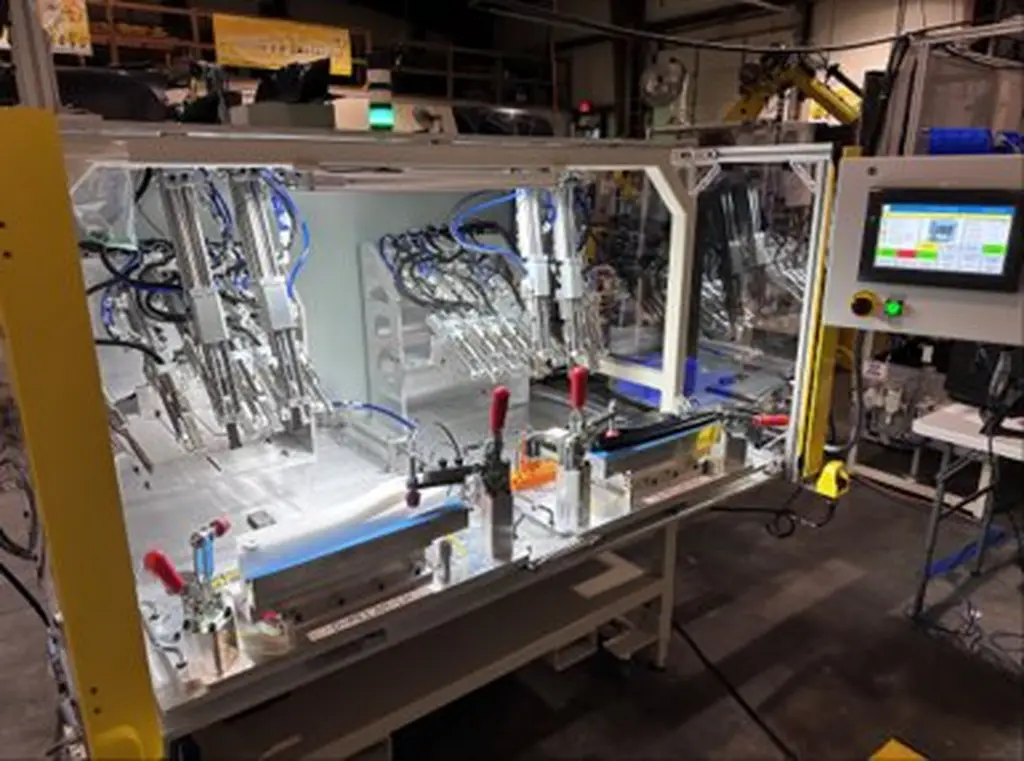
A welding robot can sound complicated, but at its core, it’s a machine arm holding a welding tool that follows a path it’s been shown ahead of time, over and over, with consistent results. This guide breaks down what robotic welding looks like in practice, including when it makes sense to use automated welding, which parts are involved, and how it all comes together seamlessly on the shop floor.
Why Welding Gets Automated
Welding is hard, physical work. It exposes people to bright arc flash, hot sparks, and fumes, and doing the exact same joint hundreds of times in a shift takes a toll on a welder’s body. The health risks to workers, combined with the increasing shortage of skilled welders, are some of the main reasons for the rising popularity of robotic welding. While robots can’t fully address the labor shortage or safety risks, robots can take on the more repetitive tasks, which frees up the skilled welders for the customized, specific work that only a person can do.
The Main Types of Robotic Welding
Similar to tools in a tool box, each type of welding robot has a unique job. Choosing the right welding robot depends on the metal, the thickness, and the desired finished look.
MIG welding, or Metal Inert Gas welding, is the most common type of robotic welding in factories. In MIG welding, a wire feeds continuously out of the torch while a shielding gas protects the weld from the air around it. It’s fast, strong, and simple for robots to learn, which makes it a great fit for high-volume work.
TIG welding, or Tungsten Inert Gas welding, uses an electrode that doesn’t melt away, plus a separate filler rod fed in by hand or machine. It’s slower than MIG, but the weld comes out cleaner and more precise. TIG welding is often used on thinner metal, like sheet metal, or parts where appearance matters, like aerospace components. It is ideal for metals that don’t have a significant amount of iron, also known as non-ferrous metals, such as aluminum, titanium, copper, and nickel alloys.
Spot welding doesn’t use any filler material. Instead, it fuses two overlapping metal sheets together. In spot welding, two electrodes clamp down on the metal pieces and pass electricity through them. The heat from that resistance fuses the metal together. Spot welding is extremely quick and ideal for high volume production, which is why it’s extremely popular in car manufacturing.
Laser welding uses a tightly focused beam of light to melt and join metal. Because the heat stays so concentrated and isn’t dissipated across the entire workpiece, there’s less warping. Laser welding is incredibly useful for small, precise jobs in the automotive industry, or for smaller products, like electronics or medical devices.
Plasma welding, also known as Plasma Arc Welding (PAW), works a bit like TIG but with a more concentrated arc, and it holds up well on metals that are trickier to weld, like stainless steel and aluminum. PAW works by constricting the arc through a fine copper nozzle, which creates a high-velocity, high-temperature jet of plasma.
Flux-cored welding is similar to MIG, but instead of an external gas tank, the shielding comes from flux packed inside the wire itself. This makes flux-cored welding incredibly useful outdoors or anywhere a gas shield would blow away or be hard to maintain.
What Is In a Robotic Welding Cell
A welding robot by itself is one part of a larger process. In order to work, a robotic welding cell requires a few key pieces:
- The robot arm itself. Welding robotic arms are typically 6-axis arms, meaning they can bend and rotate at six different joints, similar to a human shoulder, elbow, and wrist combined. That range of motion lets it reach a weld from nearly any angle.
- A power source. This controls the electrical side of the weld including voltage, current, and how fast wire feeds. Many welding robotic machines can switch between different welding settings just by loading a different program.
- A wire feeder and torch. Feeds filler wire into the joint at a steady, controlled rate, allowing consistent performance every time.
- A positioner or fixture. Holds the part in place, and often rotates or tilts it, so the robot doesn’t have to move itself into awkward positions.
- Sensors. Many modern cells use a camera or laser sensor to “see” the seam in real time, so if one part sits slightly differently than the last, the robot adjusts instead of welding in the wrong spot.
- A safety cage or barrier. Because arc welding is dangerous to be near, the cell is enclosed, with sensors that stop the robot the instant someone opens a door or steps into range.
- A control panel. The control panel is typically a touchscreen where someone loads programs, adjusts settings, and troubleshoots if something goes wrong.
How a Welding Robot Learns to Weld
Before a welding robot can carry out its function, it needs to be shown exactly where to go and how to perform its task. There are a few common ways to do this:
- Manual teaching. In this case, a worker physically guides the robot arm through the weld, step by step, using a handheld control pad. This helps the robot learn and define the proper angle, path and welding point.
- Offline programming. The path is built ahead of time using a 3D computer model of the part, so the robot already knows where to go before it ever sees the welding workpiece.
- Guided demonstration. On newer systems, a person can move a handheld device through the weld motion, and the robot copies that same path.
Once the path is set, the robot repeats it precisely, every time, unless the part itself changes and the robot needs to update its learning.
How to Tell If a Job is a Good Fit for Robotic Welding
Not every weld should be automated. Below are a few important questions to ask before deciding to incorporate welding robots into your manufacturing process:
- Does the robot physically fit the job? It is important to understand what are the limits of the robot’s reach, how much weight it can carry, and how much floor space it needs to carry out its function.
- Is the volume high enough? Robots make the most sense when a weld gets repeated often enough to justify the setup. Welding robots are optimized for consistency and speed in high-volume productions.
- Does the workpiece need to be exactly the same every time? If consistency is a critical part of the project, then a welding robot may be an ideal solution.
- Can parts be presented in an organized way? Welding robots work best when parts arrive in a predictable spot that they can pull from, such as a tray or rack, rather than a disorganized pile.
What are the Benefits of Robotic Welding for Manufacturers?
If welding robots make sense for a shop, there can be many benefits even outside of increased efficiency. Because robots can run without breaks, they often produce two to four times the output of a manual welding station over the same period. Their accuracy is incredibly tight as well. Some systems hold a weld path within a few hundredths of a millimeter, which cuts down on wasted material and rework.
One of the most important benefits of robotic welding is that it can pull workers further away from any harmful fumes, sparks and arc flash. Robotic welding allows people to shift what they spend their time on by transitioning from tedious, repetitive and dangerous welding projects into more skilled tasks such as setup, programming and custom, judgment-heavy welding that a robot cannot handle.
Sapience Automation builds robotic welding systems around the specific part in front of them, not a standard package because we understand one-size does not fit all. As a certified FANUC robotics partner, the expert team has applied this same approach to other processes, including a 9-axis system built to rotate parts at 150 rpm through a multi-step coating process, engineered around that part’s exact shape rather than adapted from an existing line.
If you’re weighing whether robotic welding makes sense for your shop, our experts would love to talk about your part, process, and if a robotic welding cell makes sense for you.