In industrial coating, one of the biggest challenges is not applying the coating; it is knowing whether the right amount has actually reached the part. Traditionally, coating thickness is often verified after curing or drying. By that point, however, the process has already happened. If the coating is too thin, the part may require rework. If it is too thick, material has already been wasted. And if the process begins to drift, several parts may be affected before the problem becomes visible. For manufacturers moving toward more automated and data-driven production, that delay becomes increasingly difficult to accept.
Moving Coating Thickness Measurement Earlier in the Process
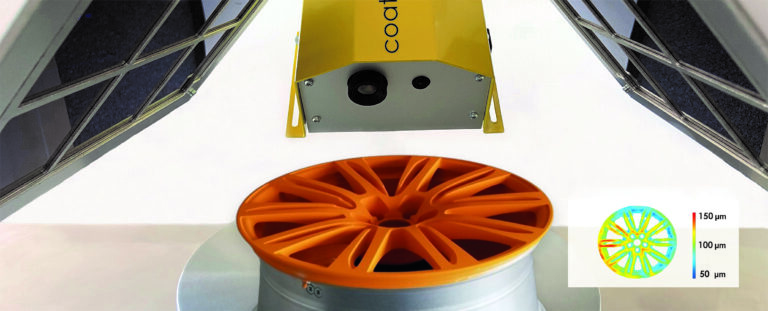
Non-contact coating thickness measurement changes where quality control takes place. Using coatmaster’s® Advanced Thermal Optics technology, coating thickness can be measured directly after application, including on wet or uncured coatings, without touching or damaging the surface. Instead of asking, “Was this part coated correctly?” after the process is finished, manufacturers can ask, “Is the process running correctly right now?” That distinction is important.
Early coating thickness data allows operators and automated systems to react while adjustments can still influence production. Spray parameters can be optimized, coating deviations can be identified sooner, and unnecessary safety margins can be reduced. The result is a coating process that is not only inspected, but increasingly controlled.
Measurement as Part of Automation
Modern coating lines already generate large amounts of process data: robot positions, gun settings, powder or paint output, conveyor speed, part identification, and environmental conditions. Coating thickness adds another critical piece of information: the actual result on the part. This makes measurement particularly valuable when it is integrated directly into the production line. coatmaster systems can support different levels of automation, from flexible handheld measurements with the coatmaster Flex to automated point measurements and full-surface thickness mapping using Inline and 3D solutions.
For automated coating systems, this data can become part of the control architecture itself. Rather than relying exclusively on predefined spray parameters, coating equipment can use measured coating thickness as feedback. When connected with the appropriate line controls, this creates the foundation for closed-loop coating processes in which application parameters can be adjusted according to the actual coating result.
Why Real-Time Coating Thickness Measurement Matters for Manufacturers
The goal is not simply to collect more data. The goal is to make coating production more predictable.
Real-time coating thickness measurement can help manufacturers:
- Identify coating deviations earlier in the process
- Reduce unnecessary coating material
- Avoid rework caused by incorrect film build
- Maintain coating specifications across changing parts and production conditions
- Document coating quality more consistently
- Support operators with objective process information
- Create the measurement feedback required for increasingly automated coating lines
This becomes especially relevant as manufacturers face tighter quality requirements, increasing material costs, and a growing need to produce consistently with less dependence on manual intervention.
From Automated Application to Automated Process Control
Installing robots and automated spray equipment is an important step toward repeatable coating production. But automation alone does not guarantee that every part receives the target coating thickness. Transfer efficiency can change. Part geometry changes. Environmental conditions change. Coating materials and application parameters change. A truly controlled process therefore needs feedback from the result itself. By combining Sapience Automation’s expertise in robotic painting and coating systems, controls, and production-line integration with coatmaster’s non-contact coating thickness measurement technology, manufacturers can bring measurement directly into the automation strategy.
The next generation of coating automation is therefore not only about applying coatings automatically. It is about measuring the result, using that information immediately, and continuously bringing the process back toward its target. That is the transition from final inspection to real-time coating control.
Interested in integrating real-time coating thickness measurement into a new or existing finishing line? Contact Sapience Automation to discuss your coating and automation requirements.